
Eternal Early Days

How much of what we believe about the world is shaped by our own experience?
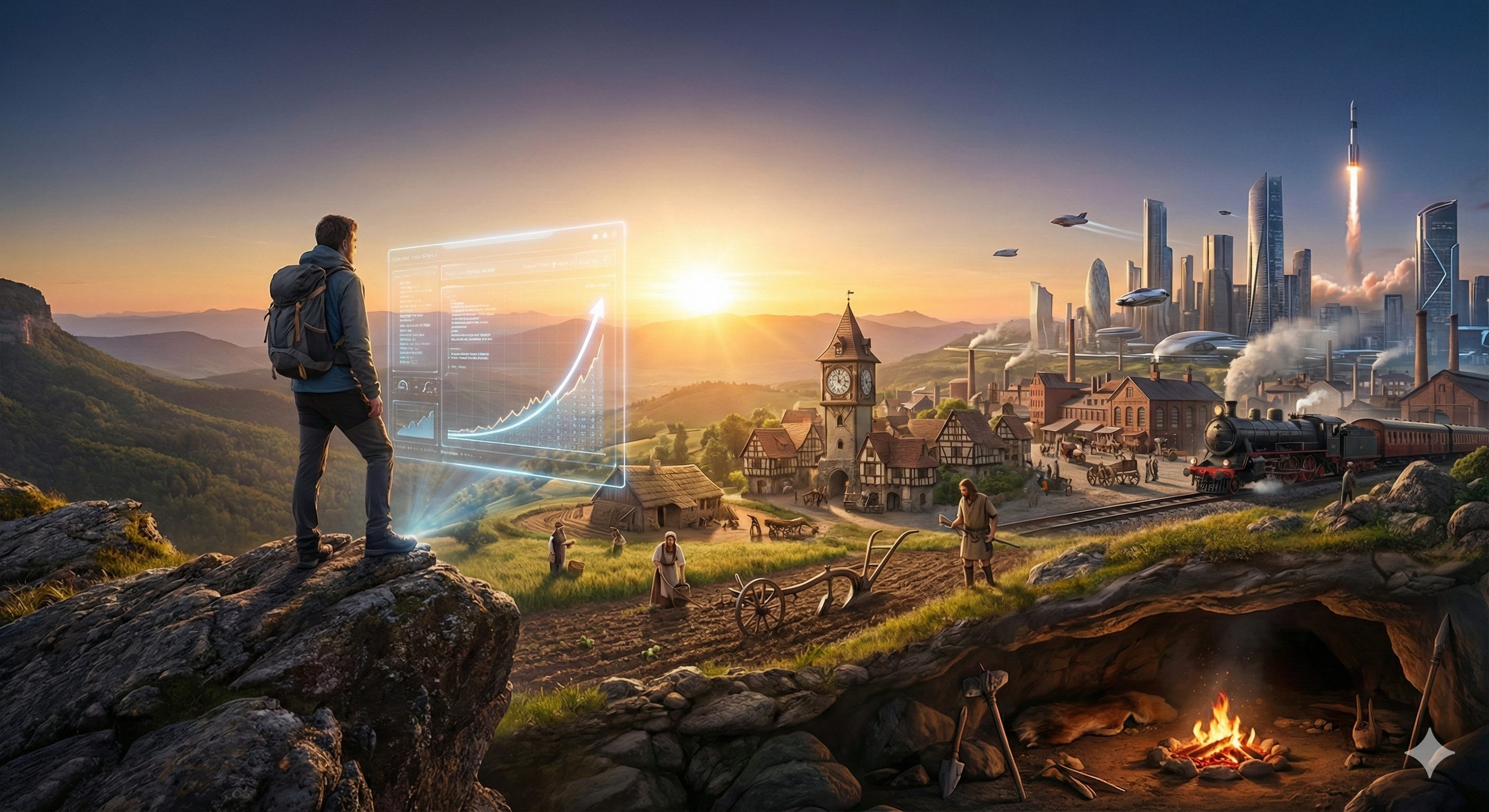
Probably 80%.
And yet, our experience accounts for just 0.0001% of all human history.
It’s easy to assume that the way things are now is how they’ve always been. But history tells a different story.
For most of human history, progress was so slow it was nearly invisible. Thousands of years passed between major breakthroughs.
A million years ago, early humans tamed fire, altering their ability to cook, stay warm, and fend off predators.
Half a million years later, they built the first shelters, offering protection from the elements.
Then spears made hunting more efficient.
Trade networks emerged, using beads and shells as currency.
Each of these advancements improved survival, yet for millennia, life remained much the same. Generations were born, lived, and died with few changes to the world around them.
Knowledge was, however, slowly compounding. Once we mastered agriculture and settled into civilizations, the invisible progress of prehistory gave way to a visible explosion of ingenuity.
By 200 BC, the Chinese had invented the compass, setting the stage for exploration. In AD 725, the first mechanical clocks allowed people to measure time precisely. In 1440, Gutenberg’s printing press revolutionized knowledge-sharing, fueling the Renaissance and the spread of ideas.
In 1769, the first self-propelled tractor hinted at the dawn of the automobile age. Each invention reshaped the way humans lived, learned, and connected.
By the 19th century, progress was no longer measured in millennia, or even centuries—it was happening within a single lifetime.
Steamships made transatlantic travel a reality.
The telephone shrank the world overnight.
The first automobile rolled onto the streets, and Nikola Tesla laid the groundwork for wireless communication.
For the first time in history, humans were actively reshaping their environment. Science and industry merged, and the pace of innovation exploded.
The Wright brothers achieved powered flight.
ENIAC, the first programmable computer, was developed.
The internet was born. The microprocessor ushered in the digital age.
… All in a span of 100 years.
By the 1980s, technology was galloping at exponential speed and becoming an inescapable part of daily life.
In the past 50 years, progress has become almost dizzying.
The first personal computers arrived in 1983.
The World Wide Web launched in 1991.
In 2007, the iPhone put a supercomputer in everyone’s pocket.
Then AI began scaling new heights in 2016, outperforming humans in complex tasks like Go.
By 2023, OpenAI’s ChatGPT made AI accessible to the masses.
We now seem to have reached a point where the curve of progress itself has gone exponential. What was once relegated to the pages of science fiction now seems like is on our doorsteps every morning.
What lessons can we take looking at this arc of technology?
If our personal experience represents only 0.0001% of history, these milestones teach us how to view the other 99.9999%:
Abandon the myth of “Normal”: For most of history, the world was static. Today, the “steady state” is gone. Our biological anxiety about rapid change is a mismatch. We are built for certainty but the lesson is to lean into the discomfort of “the new”. It is the very thing that drives us forward.
Progress is a “Ratchet,” not a Cycle: We spend too much time focused on the cycles of history—the wars, headlines, and crises. But knowledge only moves in one direction: forward. Prosperity is the result of a persistent, unstoppable problem-solving drive … not a natural outcome of stability.
The “Silent” Nature of Success: We notice the disasters, but we rarely notice the absence of problems. We no longer fear smallpox; we speak across oceans instantly; the miraculous has become mundane. To maintain perspective, we must learn to “see these silent wins”.
The Death of Expert Prediction: History is a graveyard of “expert” forecasts that failed to see the potential in new tools. In an exponential world, “realism” is just a lack of imagination. Many of our greatest leaps began as “toys” or useless curiosities. The flip-side of that is almost all of the “expert view” of new technology was wrong. LLM’s will not be the exception because history's "ratchet" suggests that new tools often find their most interesting uses in ways we haven't yet imagined.
Prosperity is Permissionless: From the Wright brothers in a bicycle shop to the early developers of the PC, progress has rarely waited for a consensus. It is driven by individuals who simply decide to build. Prosperity is something to be created, not something to wait for. And today, with the barriers to entry are lower than ever, that opportunity is endless.
Technology is the Ultimate Equalizer: Innovation eventually shrinks the gap between the elite and the masses. 300 years ago a hot bath was just for aristocracy, and 50 years ago flying was for the rich. Today its available to almost everyone in the developed world. This radical expansion of opportunity is the true meaning of prosperity.
Curiosity is the Only Future-Proof Asset: From the first fire to the latest LLM, the common thread is wonder. In a world where specific skills become obsolete faster than ever, the drive to ask “why” remains our most enduring edge.
Perhaps the most important realization is not that we are still in the early days but that we always will be in the early days. If the curve is truly exponential, the best innovations must be coming up ahead of us.
And that, more than anything, makes me hopeful about the future.