
The Gell-Mann Amnesia Effect

Michael Crichton spent a good chunk of his career around Hollywood. So entertainment news was his home turf. He knew how deals actually got made, who really had the power to greenlight, what a budget shake-up meant versus what it looked like from the outside.
Whenever he read an article about his own industry, he’d see the mistakes right away. A studio head got credit for a decision someone else made. A firing got written up with the cause and effect flipped around. Half the time the story wasn’t just missing detail, it was backwards.
Then he’d turn the page to a story about foreign policy, or some Senate vote, edited by the same desk, and he’d read it and just believe it. All of it.
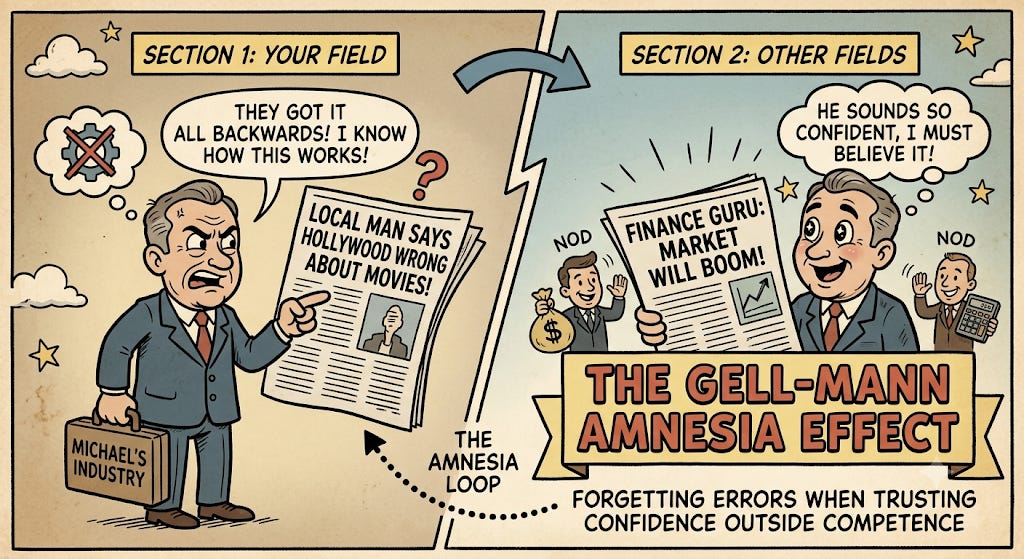
Then, one day, he was talking to the physicist Murray Gell-Mann, who said he had the exact same experience whenever physics turned up in the news. He too would watch a source get something wrong, and a minute later on a completely different subject he would find himself trusting that same source completely.
That’s what Crichton named the Gell-Mann Amnesia Effect.
I don’t think the interesting part here is that journalism gets stuff wrong. Every field does that. What’s actually interesting is what it says about how we decide who to believe at all.
Most of the time we’re not judging the information at all. We’re judging how it sounds. If someone writes with confidence and throws in a title or two, that’s usually enough for us. We tend to assume competence is one big thing a person either has or doesn’t, so once someone’s earned our trust on one subject, we seem to transfer it to subjects that have nothing to do with the first one … forgetting that knowing one thing well doesn’t transfer to the next thing.
A great cardiologist has no particular edge on inflation. A reporter who’s sharp on tech can still write complete nonsense about semiconductors. Being right about one thing tells you almost nothing about whether someone’s going to be right about the next one.
You see a smaller version of this in markets all the time. Someone calls a top, or shorts a bubble right before it pops, and after that everything out of their mouth gets treated as insight. Nobody stops to ask whether the call was actually skill or a coin flip that happened to land the right way, or whether whatever edge they had was specific to that one trade and doesn’t carry over to the next. People remember that the guy was right. They don’t ask about what, or why, or whether he’d be right again.
This is also exactly what I think is happening with AI.
A language model writes with the same even, confident tone whether it’s right or just making something up. With a human you can usually pick up on uncertainty but with an LLM there’s no tell, no hedge in the voice, when it’s bluffing … which makes the wrong answer sounds just as sure as the right one. So while the instinct is to relax around AI the more fluent and confident it sounds, it should probably go the other way.
Next time you’re reading something outside your own lane and feel that quick click of certainty, it’s worth pausing for a second and ask: would this convince me this easily if it were about the one subject I actually know? If your answer is no, you may have just side-stepped your version of Gell-Mann Amnesia.
For investing specifically, the practical version is pretty simple.
Treat a stranger’s confident call on some sector you don’t know the same way you’d treat a stranger’s confident opinion about your own field. Something to check, not something to accept just because it sounded sure of itself. A good track record in one place doesn’t buy someone credibility everywhere else. And the people actually worth listening to are usually the ones who’ll tell you when something’s outside their circle of competence, not the ones who never do.
That's really the whole skill.
Knowing where your own edge ends, and staying just as skeptical of anyone else's confidence past that point as you'd want them to be of yours.
When I was trying cases, a few attracted local media attention in the venue where they were tried, and I noticed the exact same thing. It is nice to have a term for what I recognized. Ironically, even though it made enough of an impression on me that I would often mention my experience to others, when I look at my own behavior, I think I remained about as gullible as before. There is probably a term for that as well.