
The Lindy Effect

In 1964, comedians who performed nearby would gather there after shows at Lindy's delicatessen, a New York deli, to talk about which comedians were still drawing crowds and which ones had faded away.
They theorized that the longer a comedian had been around, the longer people expected them to keep performing.
So a comedian who had been popular for 2 years was expected to remain popular for another 2.
A comedian who had been around for 20 years might stay relevant for another 20.
This became known as the Lindy Effect.
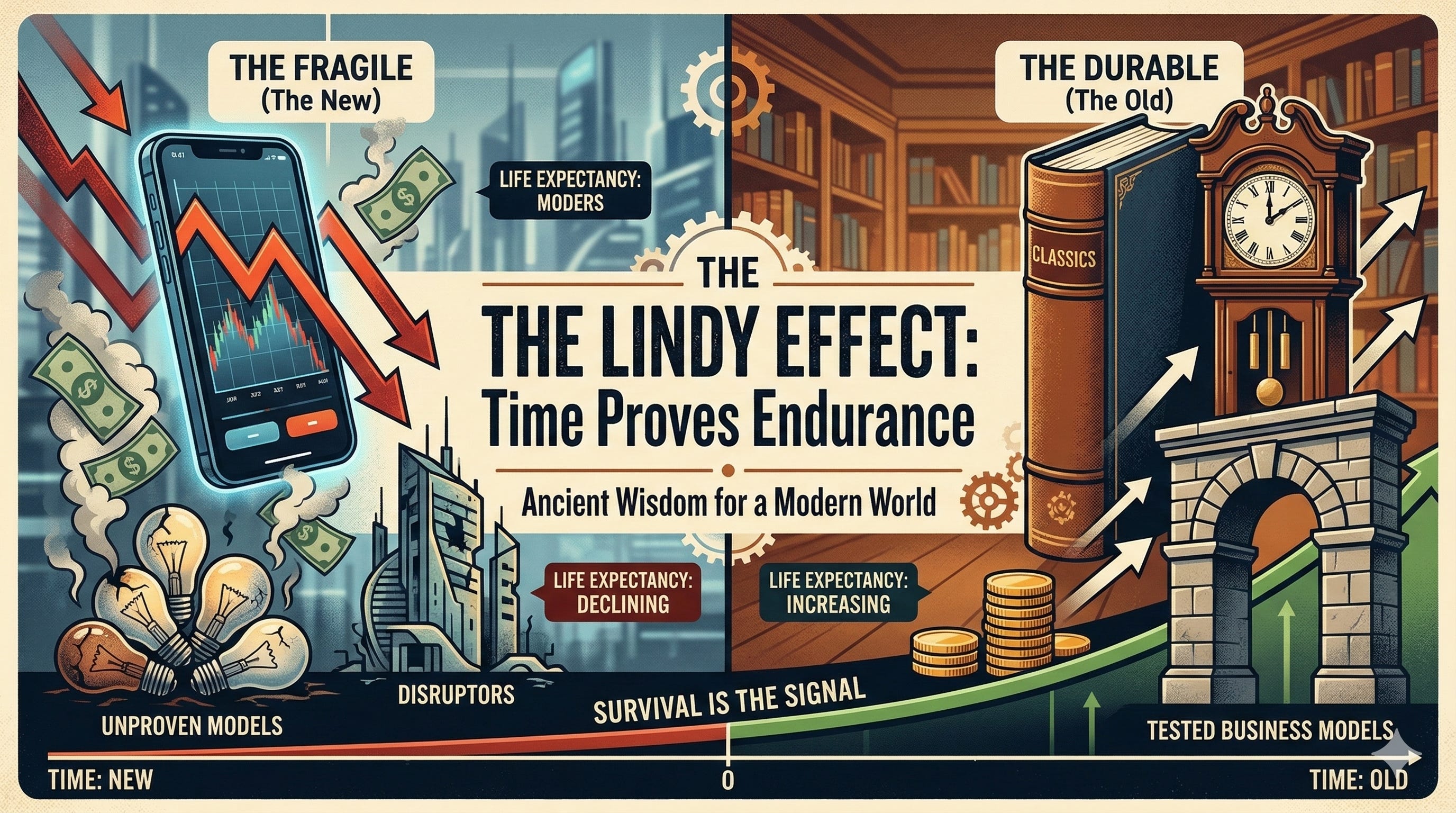
In other words, if it’s new, it’s probably fragile; if it’s old it’s durable.
This goes against the modern wisdom.
We’ve been trained to worship the “next.” The pitch deck with the unproven model, the founder promising to reinvent the wheel, the software that hasn’t seen a recession. We call it innovation. Often, it’s just a gamble with a high burn rate.
But the graveyard is full of “disruptors” that didn’t survive their first winter.
On the other end is the Lindy Effect.
It’s a simple principle for things that don’t age physically — ideas, books, business models — the longer they’ve lasted, the longer they will last.
A book that’s been in print for fifty years is proven. It has appealed to many individuals over time and so the odds say it will be here in another fifty. The bestseller from last week? Well … we’ll see in 2 weeks.
Take IBM.
For forty years, experts have been writing the mainframe’s obituary. They said the PC would kill it. Then the internet. Then the cloud. Yet, in 2026, the global financial system still runs on IBM Z.
It’s not because IBM is “cool.” It’s because when the cost of being wrong is catastrophic, “new” is a bug, not a feature. The mainframe earned its seat by refusing to die. It became the plumbing. And you don’t swap out the plumbing just because a shinier pipe hit the market.
In short, survival is the signal.
A business that has endured economic cycles, regulatory shifts, and technological pivots has something a startup cannot buy: resilience. It has solved a permanent human problem in a way that gets harder to replace every year it remains standing.
So what does this mean for us?
Depends on the lens I suppose.
I personally use Lindy effect in two ways.
One to decide which books to read. I don’t read anything that has not been around for at least 20 years (except Nassim Taleb).
The other is to decide what businesses I invest in. I am cautious about investing in anything that was not around before 2005. Reason being it tells me something about how the business might respond in the next crisis.
On both these fronts, especially in investing, Lindy has saved me enormous time, money and anxiety (NFTs anyone!?)
So the lesson of Lindy is simple.
Stop chasing the new and start understanding the durable.
By leaning into things that have already proven their resilience, you lower your risk and increase your odds of long-term success.