
The Red Queen Hypothesis

Some ideas give you new information. Others give you a new way to see information you already had.
The Red Queen Hypothesis belongs in the second category.
Once you grasp it, the world starts to look less like a set of stable positions and more like a set of moving races.
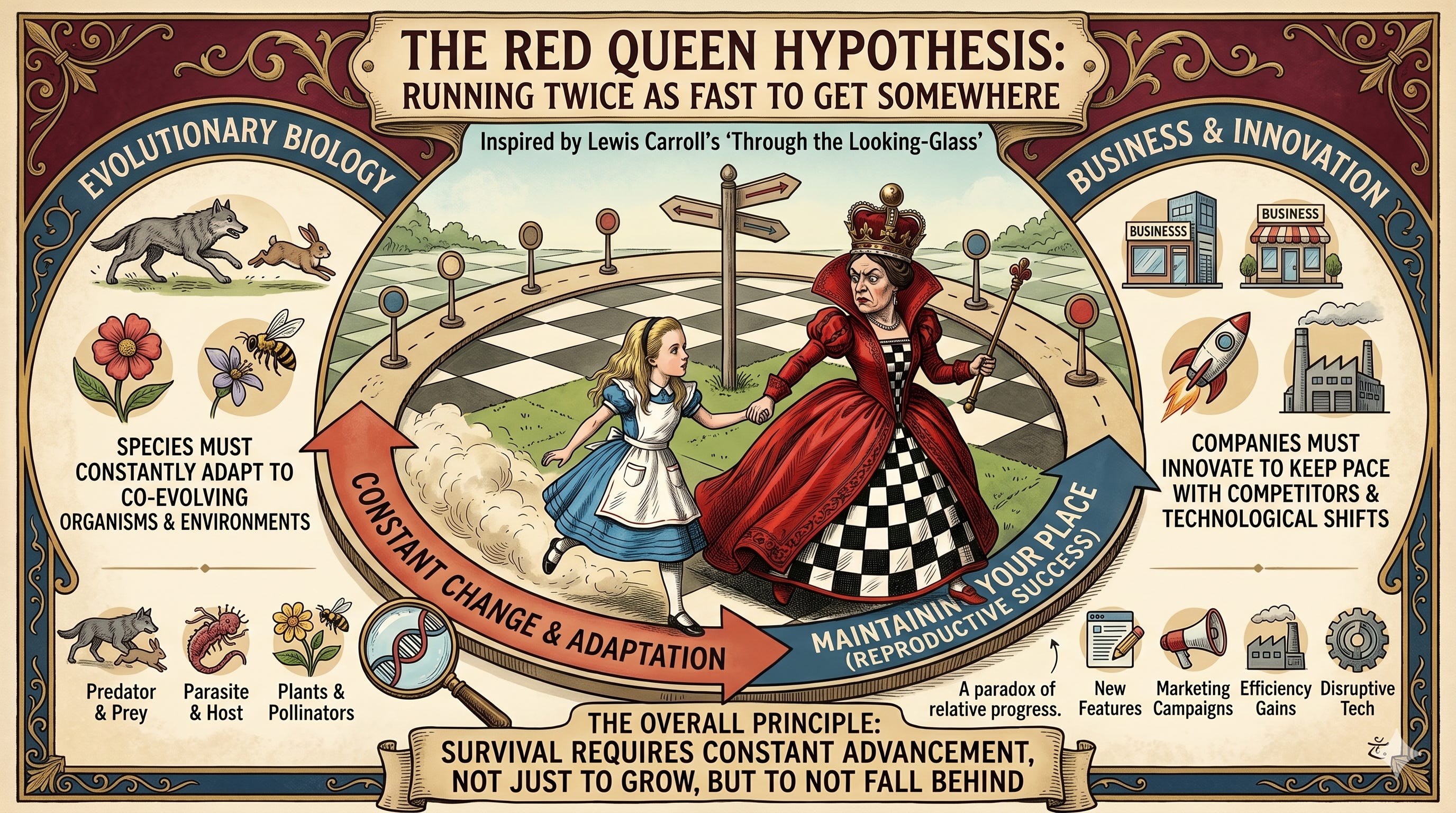
Leigh Van Valen coined the phrase in 1973, borrowing the Red Queen from Through the Looking-Glass, who has to run as fast as she can just to stay in the same place.
That image captured a serious claim about evolution.
Species do not adapt in isolation. They adapt to one another.
The environment is not just climate or geography. It also includes predators, parasites, prey, and hosts, all of which are changing at the same time.
That is why the idea lands so hard once you understand it.
We tend to imagine adaptation as temporary. You improve, you catch up, and eventually you arrive. But many systems do not work that way. In systems shaped by competition and response, there is no final resting point.
The target keeps moving because the environment itself is alive.
Standing still is simply a slower way of falling behind.
The familiar image is the chase between a cheetah and a gazelle.
The gazelle does not need to become invulnerable. It only needs to become a little harder to catch. That, in turn, puts pressure on the cheetah to improve. Neither side gets to stop. What looks like dramatic motion is, in one sense, maintenance. They are running in order to preserve roughly the same odds they had before.
Predator and prey are only the easiest illustration.
The deeper logic becomes even clearer in host-parasite relationships. Parasites evolve new ways to exploit hosts; hosts evolve new defenses; each improvement becomes the next problem for the other side to solve. Nobody wins permanently. The system remains dynamic because every gain changes the pressure on everyone else. That is Red Queen logic in its pure form.
Once you see that pattern in biology, it becomes hard not to see it elsewhere.
Careers live inside as do businesses.
A company cannot keep doing what worked five years ago and assume the market will politely hold still. Competitors copy. Customers change. Technology shifts the terrain under everyone’s feet.
The same is true for individuals: skills that once signaled ambition become ordinary, and tools that once made someone early become basic literacy. Much of modern life is a Red Queen race wearing different clothes.
This is what makes the hypothesis so useful outside science.
It explains why effort can feel strangely non-accumulative, why competence has to be renewed, and why maintenance is often confused for stagnation.
The lesson is not that progress is impossible.
It is that progress in adaptive systems is relative. Your gains matter, but so do everyone else’s.
Seen that way, the practical value of the idea is immediate.
It encourages a healthier relationship with repetition, updating, and continuous learning. A lot of what feels frustrating in work and life is actually evidence that improvement is the cost of remaining viable.
The Red Queen Hypothesis names something most people already sense but rarely articulate because much of life is spent running on terrain that keeps shifting under our feet.
The mistake is to treat that effort as temporary.
More often, it is simply the condition of staying in the race.